
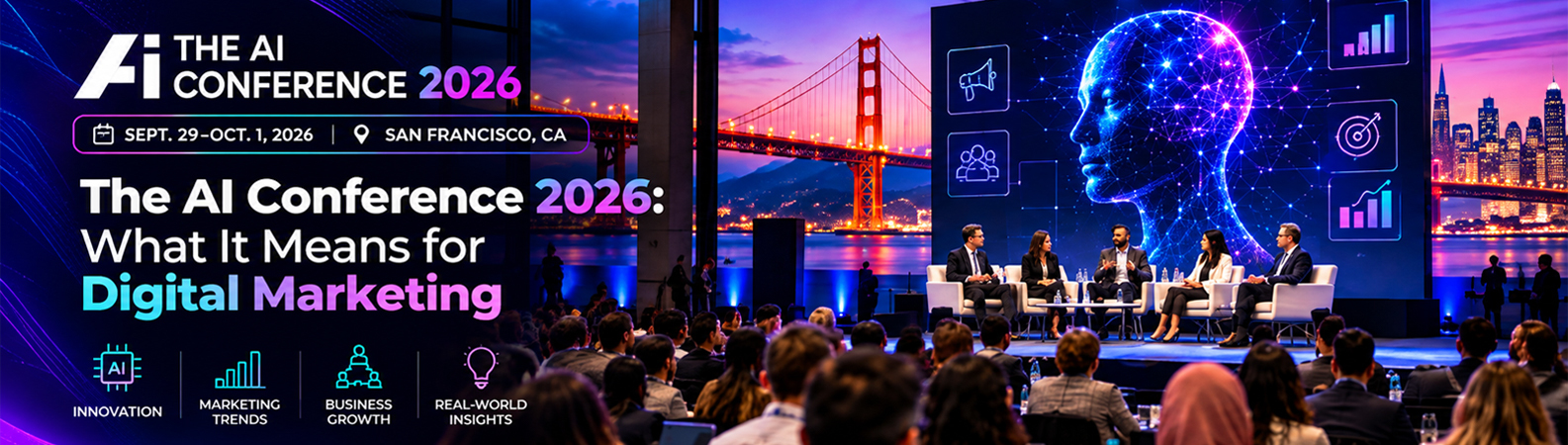
The AI Conference 2026: What It Means for Digital Marketing
A business owner doesn’t usually wake up thinking about AI models, AI infrastructure, or agentic systems.
You wake up thinking about customers.
How do we get more qualified leads? Why did our website traffic drop? How can our team respond faster? Where are we wasting time? And what will customers expect from us six months from now?
AI is increasingly becoming part of those conversations.
That is what makes The AI Conference 2026 interesting for businesses. Taking place in San Francisco from September 29 through October 1, 2026, the event brings together AI builders, researchers, founders, executives, and technology leaders to discuss applied AI, AI agents, infrastructure, enterprise adoption, product development, strategy, security, governance, and real-world implementation.
For U.S. business owners, founders, and marketing decision-makers, the bigger question is not simply, “What will be discussed at the conference?”
It’s:
What could these developments mean for the way you market, sell, serve, and grow your business?
That’s the conversation we’re interested in.
What Is The AI Conference 2026?
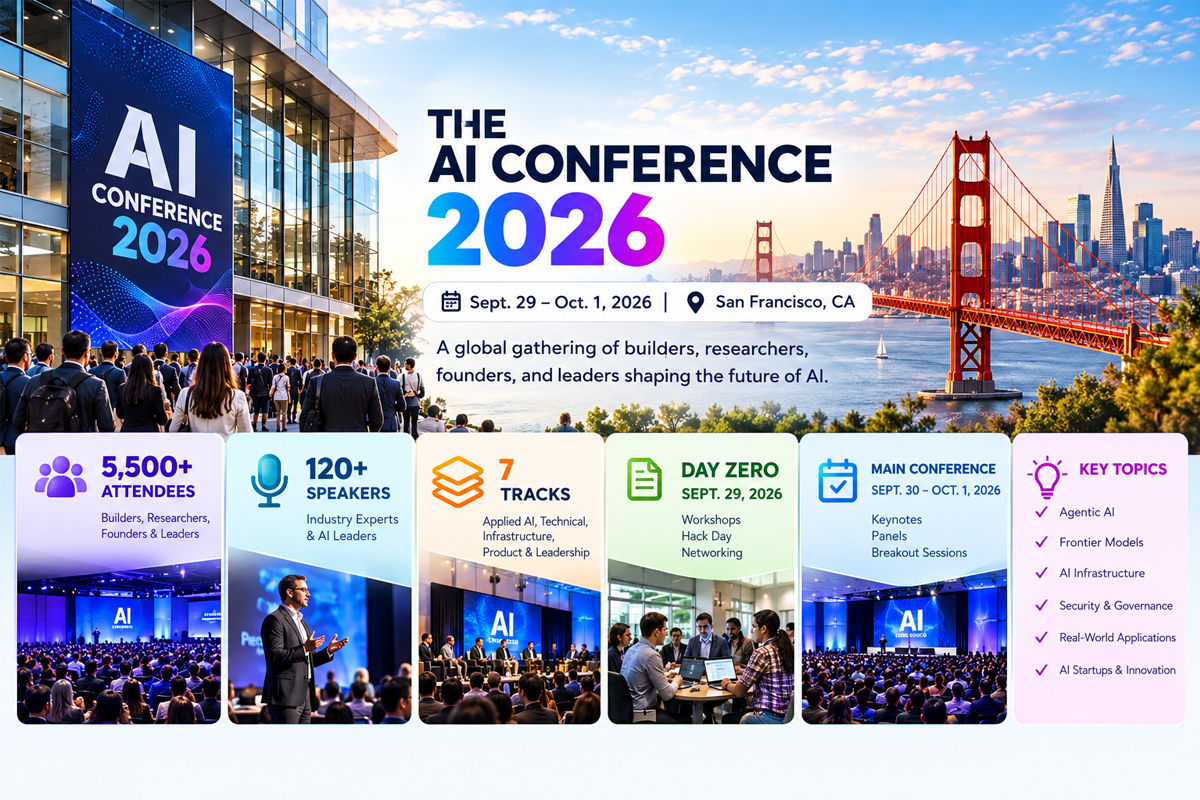
The AI Conference 2026 is a San Francisco-based event focused on the development, adoption, and real-world application of artificial intelligence.
The 2026 conference runs from September 29 to October 1, 2026, with Day ZERØ taking place on September 29 and the main conference running September 30 and October 1. The event is centered on topics including Agentic AI, AGI, frontier models, AI infrastructure, security, governance, evaluation, AI startups, emerging architectures, and real-world enterprise applications.
The conference is expected to bring together more than 5,500 builders, researchers, founders, and leaders, with 120+ speakers across seven tracks covering applied AI, technical topics, infrastructure, product, and leadership.
What Happens on Day ZERØ?
Before the main conference begins, September 29 is dedicated to Day ZERØ, a smaller, more hands-on experience capped at 350 participants.
The day includes eight focused workshops across technical and leadership tracks, a live AI Hack Day, networking, and an evening mixer. The technical track covers areas such as model development, RAG, infrastructure, evaluation, AI agents, and real-world deployment. The leadership track focuses on AI roadmaps, product strategy, governance, organizational change, and scaling AI in production.
For business leaders, one theme stands out: AI adoption requires more than experimenting with a chatbot.
The event's leadership programming is designed around practical decisions such as where to invest, how to evaluate AI opportunities, and how to bring AI into an organization responsibly.
A Look Back at The AI Conference 2025
Before looking ahead to 2026, it helps to understand what the previous conference focused on.
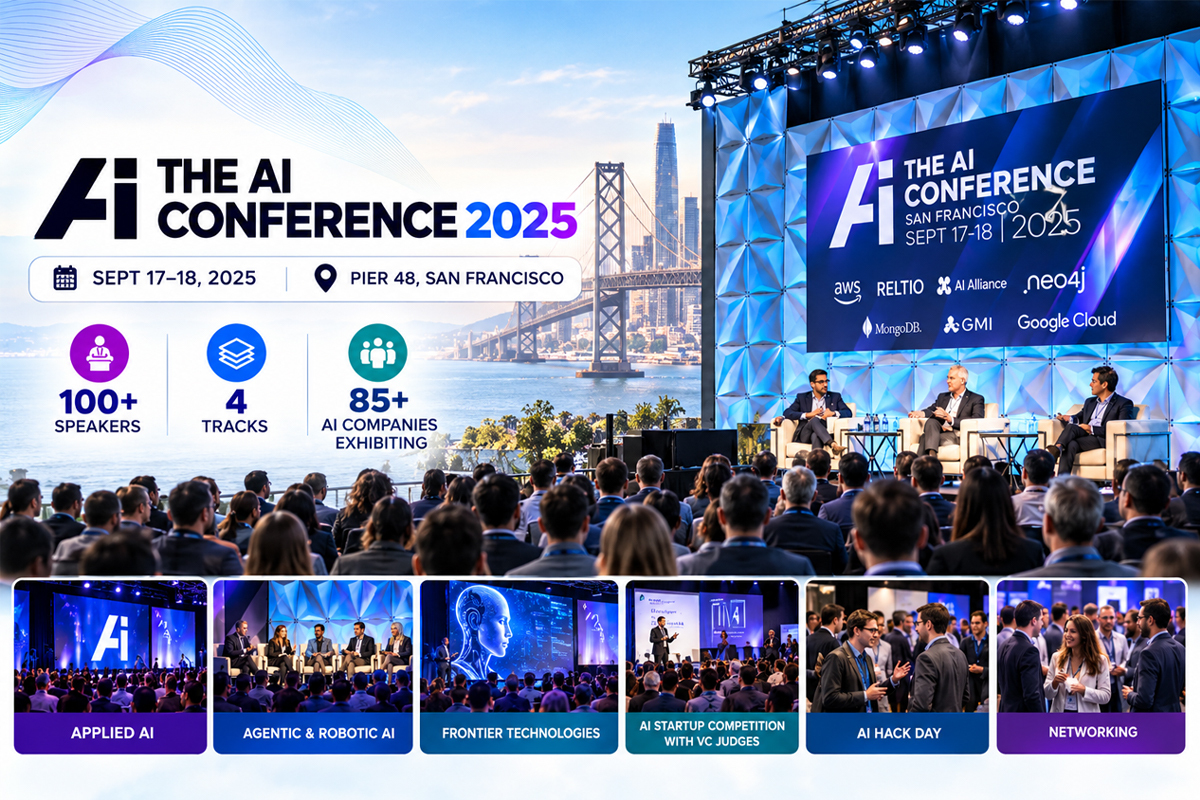
The AI Conference 2025 took place September 17–18 at Pier 48 in San Francisco. The two-day event featured more than 100 speakers, four tracks, and 85+ AI companies exhibiting. Its program covered applied AI, Agentic and robotic AI, frontier technologies, a live AI startup competition with VC judges, networking, and an AI Hack Day.
The 2025 event also brought together a broad AI community spanning researchers, engineers, entrepreneurs, startups, and investors. It focused on connecting AI research and innovation with practical applications and commercialization.
What Happened at the 2025 Conference?
The 2025 event focused heavily on where AI was heading and how emerging technologies could move beyond research and experimentation.
One notable conversation centered on Agentic AI and systems capable of carrying out more complex tasks rather than simply responding to individual prompts. The event also explored AI-powered devices, healthcare applications, data science, and other areas where AI was beginning to influence real-world products and services.
That matters as we look ahead to 2026.
The conversation is increasingly shifting from:
“What can AI do?”
to:
“How can businesses actually use it?”
Key Lessons From the 2025 Event
One of the clearest takeaways from the 2025 discussions was the growing importance of practical AI applications.
AI may look impressive in a demonstration, but businesses ultimately need systems that work in real environments.
That means thinking about:
Moving Beyond AI Experiments
Testing an AI tool is easy. Integrating it into a workflow, measuring its performance, and making it useful for employees or customers is much harder.
The Growing Role of Agentic AI
The 2025 program included dedicated discussion around Agentic AI, reflecting growing interest in systems that can perform more complex, multi-step tasks.
AI Needs Context
A powerful model does not automatically understand your customers, business processes, brand, or goals. Businesses still need strategy and domain knowledge around the technology.
Real-World Applications Matter
The conference’s focus extended beyond models themselves into areas such as healthcare, devices, data, and products, showing how broadly AI can intersect with business and society.
What to Expect at The AI Conference 2026
If 2025 helped highlight the practical side of AI, the 2026 program takes that conversation further.
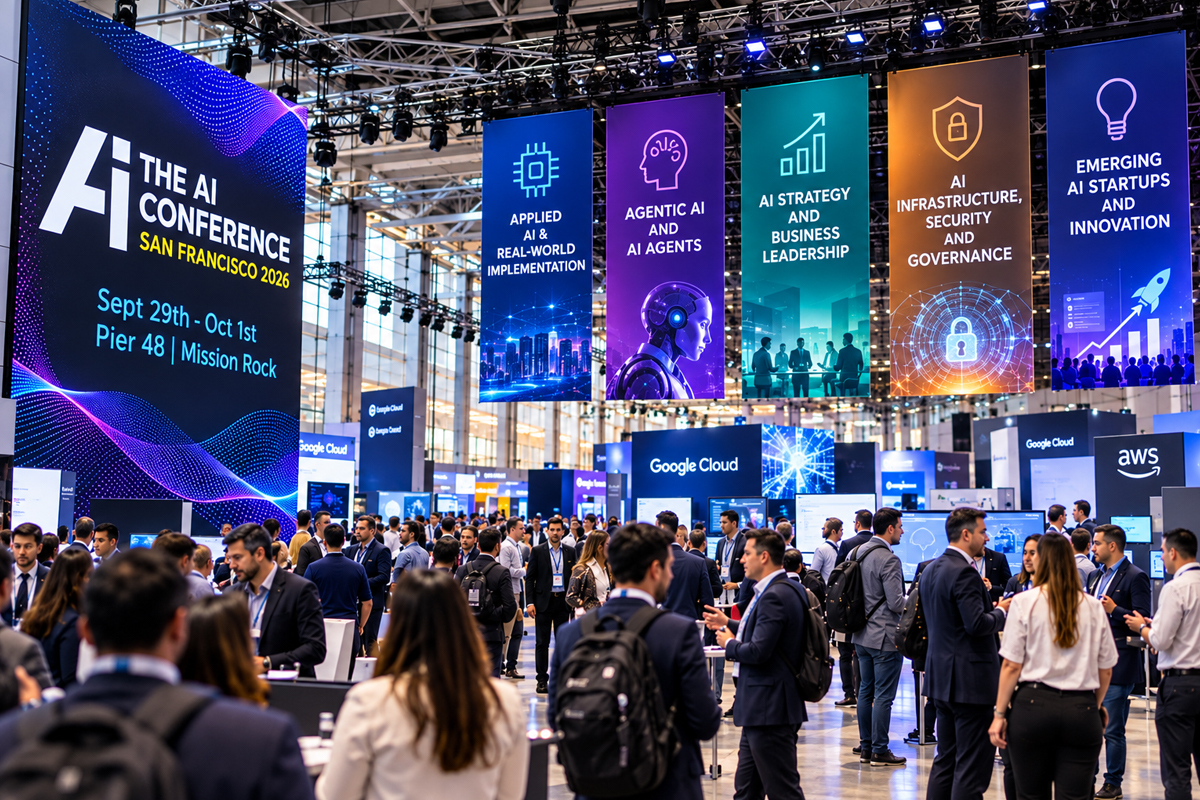
The official 2026 agenda includes sessions and panels covering AI economics, responsible AI, AI transformation, agentic systems, AI-generated content workflows, AI infrastructure, security, regulation, and building AI-native companies.
Here are some of the areas worth watching.
Applied AI and Real-World Implementation
The 2026 program puts significant attention on applied AI and how teams move from experimentation to real-world implementation.
For businesses, this could mean using AI for customer support, analytics, marketing workflows, internal operations, or repetitive tasks.
Agentic AI and AI Agents
AI agents can perform multiple steps toward a goal, often working with tools, data, or other systems instead of simply responding to a prompt.
That makes Agentic AI particularly relevant for businesses. Marketing teams, for example, could use AI-supported workflows to assist with reporting, campaign analysis, and other multi-step tasks while people oversee the process.
AI Strategy and Business Leadership
AI adoption doesn’t begin with buying a tool. It begins with identifying a business problem worth solving.
The Day ZERØ leadership track covers AI roadmaps, product strategy, governance, organizational change, and scaling AI in production—areas that can help businesses think beyond short-term experimentation.
AI Infrastructure, Security and Governance
As businesses use AI more widely, security, governance, evaluation, and responsible deployment become increasingly important.
This matters for marketing teams too. Using AI for customer data, content, personalization, or communications requires attention to accuracy, privacy, brand consistency, and human review.
Emerging AI Startups and Innovation
The conference will also feature an expanded Innovation Hub and Startup Showdown, giving attendees a look at emerging AI companies, tools, and platforms.
For business leaders, this offers a useful view of the technologies that could influence how companies work, market, sell, and serve customers.
What Does The AI Conference 2026 Mean for Digital Marketing?
For digital marketers, the conference isn't just about technology.
It's about how technology could change the way businesses attract, engage, understand, and retain customers.
AI Is Changing How Businesses Create Content
AI can speed up research, content ideas, analysis, and repetitive marketing tasks.
But faster content isn't automatically better. Accuracy, originality, useful information, and brand voice still determine quality.
Search Is Becoming More AI-Driven
Search is becoming more conversational, with AI-generated answers appearing alongside traditional results.
Businesses need useful, credible content that clearly answers customer questions. This makes SEO, AEO, and GEO increasingly important.
Data Can Make Marketing More Personalized
AI can analyze customer signals such as searches, page visits, and campaign interactions.
These insights can help businesses create more relevant and useful customer experiences.
Automation Can Improve Marketing Workflows
AI automation can reduce repetitive work such as reporting, content research, lead nurturing, and performance analysis.
This gives marketing teams more time for strategy, creativity, and decision-making.
AI Does Not Replace Marketing Strategy
AI can create content and automate tasks, but it doesn't automatically understand your audience, positioning, or brand.
AI is a tool. Strategy determines how you use it.
What Digital Marketers Should Watch at The AI Conference 2026
If you're a U.S. business owner or marketing decision-maker following the event, we'd keep an eye on these seven areas:
1. Agentic AI and marketing automation
How are AI agents moving from demonstrations into practical business workflows?
2. AI-powered search and discovery
How are businesses preparing for customers who increasingly use AI to find and evaluate information?
3. AI content workflows
Where can AI speed up content operations without lowering quality?
4. Personalization
How can businesses use customer signals to create more relevant digital experiences?
5. AI governance and responsible marketing
What safeguards are businesses putting around AI-generated content, customer data, and automated decisions?
How Artxpro Global Helps Businesses Navigate the AI-Driven Digital Landscape
Here's the part that matters most to us at Artxpro Global.
You don't need to chase every new AI trend. You need to understand which technologies can actually help your business grow.
As an AI-driven best digital marketing agency in Texas, we combine AI-powered tools with marketing strategy to improve visibility, understand audiences, streamline workflows, and create stronger digital experiences.
Our services include SEO, digital marketing, website development, social media marketing, eCommerce management, branding, and AI-supported marketing solutions.
Whether you're a startup trying to build visibility, an established company looking to modernize your marketing, or an enterprise that needs a scalable digital strategy, the goal is the same: use technology with purpose.
And if The AI Conference 2026 leaves you thinking, “We need to do more with AI, but we're not sure where to start,” Artxpro Global can help you turn that opportunity into a practical digital strategy
Ready to Build a More AI-Ready Digital Strategy?
The AI landscape is moving quickly. Your marketing strategy doesn't need to chase every trend but it does need to keep moving.
At Artxpro Global, we help businesses bring together AI, automation, SEO, content, websites, and digital marketing into strategies built around real business goals.
If you're looking for a partner to turn AI opportunities into practical digital growth, let's build a strategy that works for your business, not just one that sounds good in an AI trend report.
Ready to take the next step? Connect with Artxpro Global and build a smarter digital strategy for what's next.
FAQs
When is The AI Conference 2026?
The AI Conference 2026 runs from September 29 through October 1, 2026, in San Francisco. September 29 is Day ZERØ, followed by the main conference on September 30 and October 1.
Where is The AI Conference 2026 being held?
The event is being held at Pier 48 in Mission Rock, San Francisco, California.
What is The AI Conference 2026 about?
The conference focuses on areas including Agentic AI, AI agents, frontier models, infrastructure, security, governance, evaluation, startups, emerging architectures, and real-world enterprise applications.
What happened at The AI Conference 2025?
The AI Conference 2025 was held September 17–18 at Pier 48 in San Francisco. It featured 100+ speakers, four tracks, more than 85 exhibiting AI companies, applied AI sessions, agentic and frontier AI topics, a startup competition, networking, and a Hack Day.
Why does The AI Conference 2026 matter to digital marketers?
It can help marketers understand how developments in AI agents, automation, AI search, content, personalization, and enterprise AI could affect digital marketing and customer experiences.

Digital Marketing Specialist
With a solid 12+ year background in digital marketing, Danyal delivers blogs packed with timely insights, useful tips, and impactful stories. His writing style is engaging, informative, and always rooted in real-world value for businesses and readers. From breaking down SEO strategies to exploring ecommerce trends and keeping tabs on what’s going viral online, he keeps it fresh, fun, and totally binge-worthy. If it’s worth knowing in the digital world, Danyal’s already writing about it.

A results-driven digital agency crafting bold strategies and creative solutions that help brands grow, connect, and thrive in today’s digital-first world.