
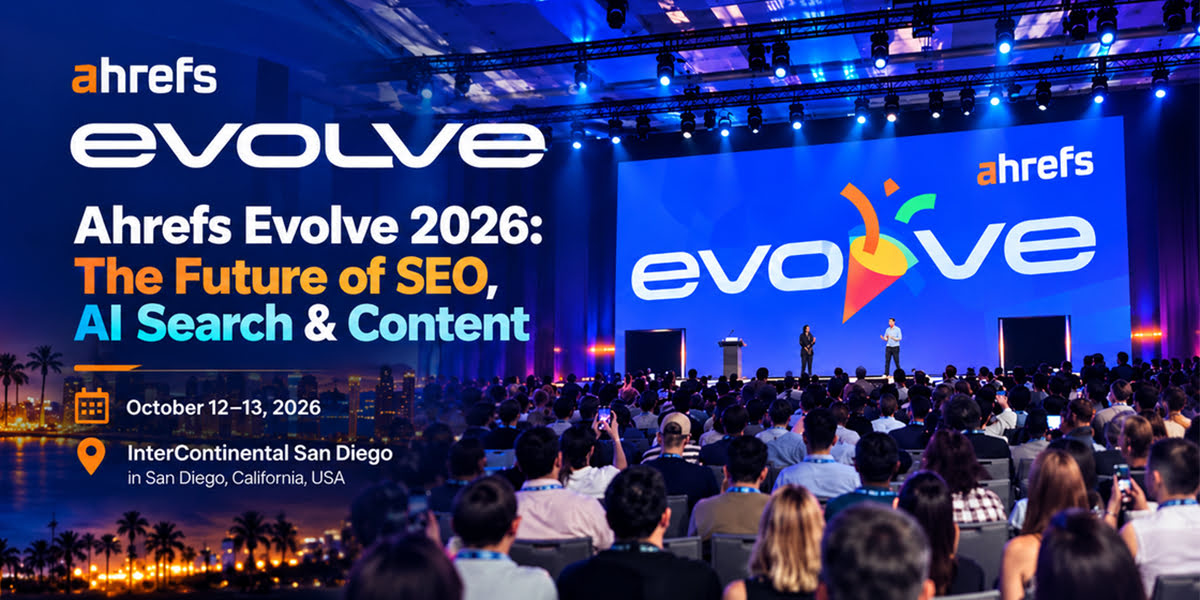
Ahrefs Evolve 2026: The Future of SEO, AI Search & Content
Search used to feel relatively straightforward. A customer searched Google, your business appeared in the results, and a strong SEO strategy helped you rank higher.
That journey is changing.
Today, your potential customers may search Google, ask an AI tool a question, compare recommendations inside an AI-generated answer, or look for a brand without ever clicking a traditional search result. For business owners, that raises a bigger question: How do you stay visible when search itself is changing?
That is one reason Ahrefs Evolve 2026 deserves attention.
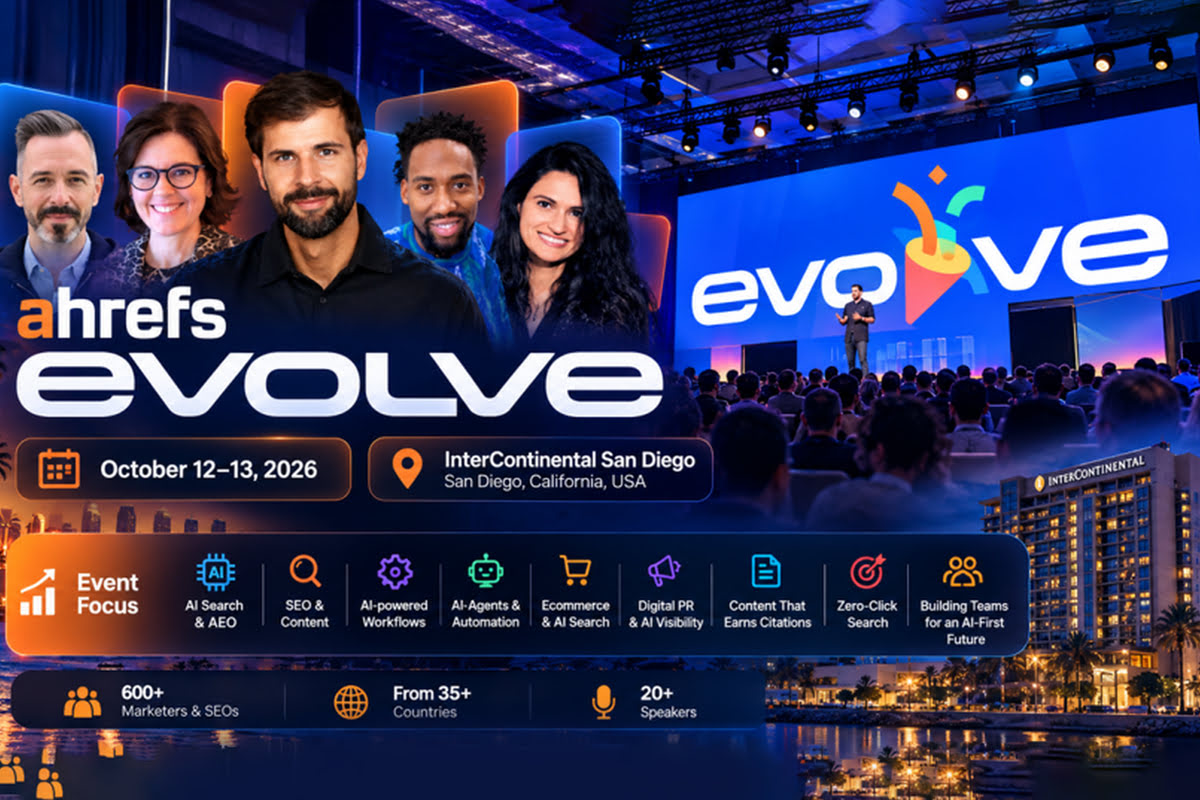
Taking place October 12–13, 2026, at the InterContinental San Diego, the event brings together more than 600 marketers and SEO professionals from 35+ countries. The official agenda features 20+ speakers and focuses heavily on AEO, SEO, AI search, content, and the practical workflows marketers are using to adapt to modern search.
What Is Ahrefs Evolve 2026?
Ahrefs Evolve 2026 is a two-day SEO and marketing conference focused on modern search, AI, AEO, content, and how businesses become discoverable online.
The event will take place on October 12–13 at the InterContinental San Diego in California. Ahrefs describes Evolve as a conference built around real workflows and practical approaches to AEO, SEO, and modern search rather than theory alone.
When and Where Is Ahrefs Evolve 2026?
- Date: October 12–13, 2026
- Location: InterContinental San Diego, California
- Focus: SEO, AEO, AI search, content, and modern marketing
- Expected community: 600+ marketers and SEOs from 35+ countries
- Speakers: 20+ marketing and SEO leaders
The speaker lineup includes marketing and SEO professionals such as Tim Soulo of Ahrefs, Ann Handley, Rand Fishkin, Aleyda Solis, Ethan Smith, Ross Hudgens, Austin Lau, and Tara Robertson.
What Will Ahrefs Evolve 2026 Focus On?
The 2026 agenda goes well beyond traditional keyword rankings.
It includes sessions around:
- AI search and AEO
- SEO and content distribution
- AI-powered marketing workflows
- AI agents and marketing automation
- Ecommerce in the age of AI search
- Digital PR and AI visibility
- Content that earns citations in AI answers
- Zero-click search and changing attribution
- Building marketing teams for an AI-first environment
That mix tells us something important: the future of SEO is increasingly connected to content, brand visibility, AI, and the broader digital marketing strategy.
Why Ahrefs Evolve 2026 Matters for Digital Marketing
If you own a business, you probably don't care about SEO because you enjoy watching ranking reports.
You care because you want customers to find you.
That distinction matters.
A strong SEO strategy can help your business appear when someone is researching a service, comparing solutions, looking for a product, or trying to solve a problem your company can address. But the way people perform that research is becoming more varied.
Search can now involve traditional results, featured answers, AI-generated responses, videos, forums, social platforms, and other sources of information.
That's why SEO increasingly sits inside a much larger digital marketing conversation.
Your website needs useful content. Your brand needs authority. Your pages need to answer real questions. Your content needs to match search intent. And your business needs to think about where customers may encounter your brand beyond a traditional blue link.
Ahrefs Evolve 2026 matters because its agenda reflects this wider shift from traditional search optimization toward modern search visibility.
How AI Is Changing the Way People Search
Imagine someone looking for a commercial cleaning company in San Diego.
A traditional search might be:
“commercial cleaning companies San Diego.”
An AI-assisted search could be much more specific:
“What should I look for when choosing a commercial cleaning company for a 50,000-square-foot office in San Diego?”
The second question gives an AI system more context. It also changes what useful content looks like.
Instead of creating a page simply because it contains a keyword, businesses need to understand the question behind the search.
That’s where AI in SEO becomes important.
1. From Rankings to Visibility
Ranking on page one still matters. But visibility can happen in more places than traditional search results.
Your brand may be mentioned, cited, recommended, or used as a source within an AI-generated response. That makes AI search visibility an increasingly relevant consideration for businesses competing online.
The Ahrefs Evolve agenda directly addresses this shift, including sessions on making businesses discoverable in the age of AI and improving visibility across AI-driven search experiences.
2. From Keywords to Search Intent
Keywords still provide valuable signals, but they shouldn’t be the entire strategy.
A better approach asks:
- What is the customer trying to accomplish?
- What information do they need before deciding?
- What questions are they likely to ask next?
- What would make them trust one business over another?
This is where modern SEO strategy and content planning start to overlap.
3. From Content Volume to Content Value
AI makes it easier to produce content. That doesn’t automatically make every piece useful.
For a business, publishing hundreds of generic pages isn’t the same as building a strong resource library.
Useful content needs a reason to exist. It should answer a real question, demonstrate knowledge, provide evidence where appropriate, and give readers something they can actually use.
That principle becomes even more important when thinking about content optimization for AI search.
What Ahrefs Evolve 2026 Could Mean for SEO Strategies
Because Ahrefs Evolve 2026 has not taken place yet, we can’t claim its sessions will produce specific results or recommendations. But its published agenda gives businesses a clear idea of the areas worth watching.
The Growing Role of Answer Engine Optimization
Answer engine optimization, or AEO, focuses on helping content become useful and visible in answer-driven search experiences.
The idea is simple: don’t only ask, “How can we rank for this keyword?”
Also ask:
“Can our content provide the clearest, most useful answer to the question?”
That shift can influence how businesses structure pages, answer FAQs, build topical authority, and organize information.
The Role of Generative Engine Optimization (GEO)
Generative engine optimization (GEO) helps businesses improve their visibility in AI-generated answers by creating clear, relevant, and trustworthy content that AI systems can reference.
Adapting SEO for AI Search
SEO for AI search doesn’t mean abandoning traditional SEO.
Technical health, relevant content, links, search intent, website quality, and strong information architecture still matter. But businesses also need to think about how their information may be interpreted, referenced, and surfaced by AI systems.
Ahrefs Evolve’s agenda includes dedicated discussions around AI search, AEO, AI visibility, and the changing mechanics of discovery.
Building a Stronger Content Strategy
Your content should support the customer journey rather than simply fill a publishing calendar.
That means creating useful resources for people who are:
- Discovering a problem
- Researching solutions
- Comparing providers
- Evaluating products or services
- Ready to make a purchase
A thoughtful SEO content strategy connects those stages instead of treating every blog post as an isolated ranking opportunity.
Measuring More Than Traditional Rankings
Rankings are useful, but they don’t tell the whole story.
A business also needs to understand whether its visibility is bringing qualified traffic, brand awareness, engagement, leads, and customers.
As search becomes more complex, measuring the broader impact of SEO and content becomes increasingly important.
How Ahrefs Evolve 2026 Can Influence Content Strategy
One of the most interesting parts of the event is how closely its agenda connects search with content.
For businesses, that connection can translate into several practical areas to watch.
Creating Content Around Real Questions
Instead of starting with a keyword and forcing it into an article, start with the customer’s problem.
What are they asking? What information are they missing? What would help them make a better decision?
Answer those questions clearly.
Building Topic Authority
One article rarely establishes a business as an authority.
A stronger AI content strategy can build connected resources around a subject, covering related questions and different stages of the buyer journey.
Improving Existing Content
Not every SEO opportunity requires a brand-new article.
Sometimes the better opportunity is an existing page that could be clearer, more complete, more current, or better aligned with search intent.
Regular content updates can help businesses maintain useful resources as customer questions and search behavior change.
Making Content Easier to Understand
AI systems and people have something in common: both benefit from clear information.
Logical headings, direct answers, useful context, descriptive language, original insights, and well-organized information can make a page easier to understand.
This is an important part of content optimization for AI search without turning every sentence into an attempt to “write for AI.”
Connecting Content With Business Goals
A blog shouldn’t exist only to attract visitors.
The best content should help move the right audience toward the next step, whether that’s exploring a service, requesting information, comparing solutions, or contacting your team.
That’s where SEO becomes part of a complete digital marketing strategy.
Why SEO, AI, and Content Need to Work Together
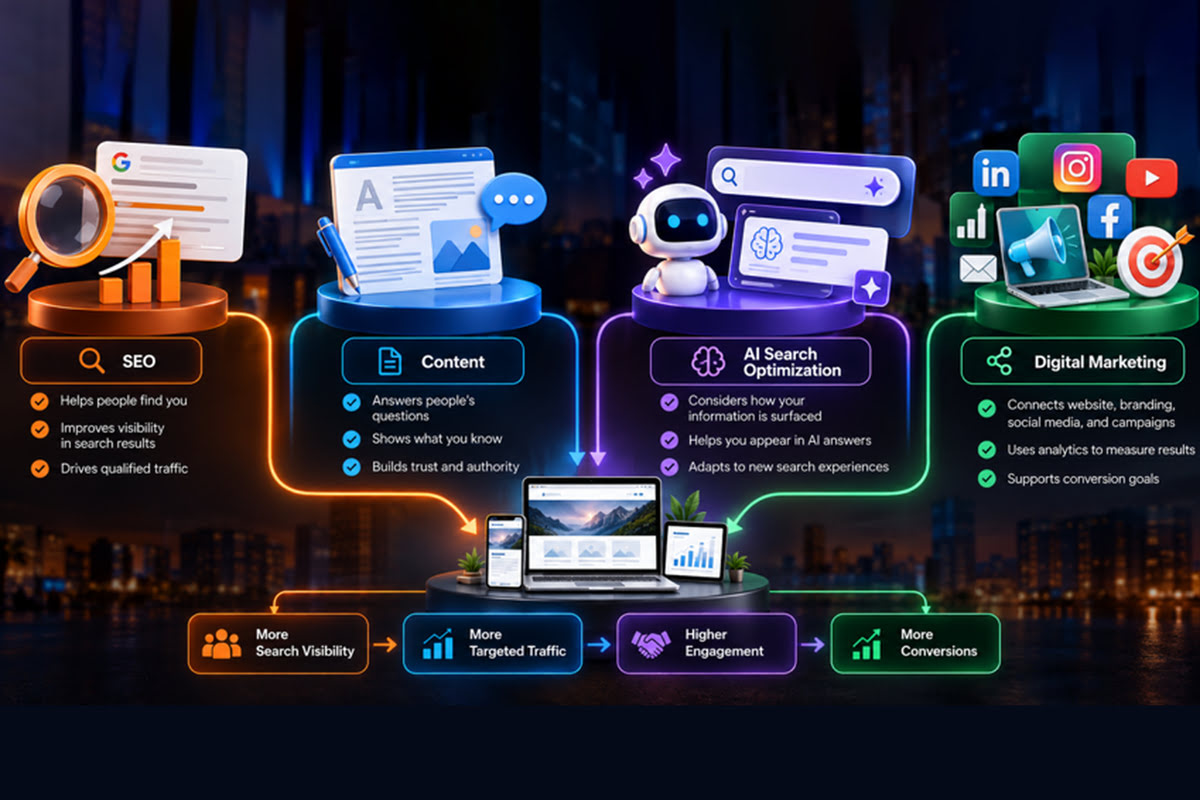
Think of your digital presence as a connected system.
- SEO helps people find you.
- Content helps answer their questions and demonstrate what you know.
- AI search optimization considers how your information may be surfaced in newer search experiences.
- Digital marketing connects these efforts with your website, branding, social media, campaigns, analytics, and conversion goals.
When these pieces work separately, you can lose opportunities.
You might have excellent content that nobody finds. You might rank well but fail to answer the customer’s real question. Or you might generate traffic without giving visitors a clear reason to take the next step.
A connected strategy brings those pieces together.
And that is one of the bigger ideas worth watching as Ahrefs Evolve 2026 approaches.
How Artxpro Global Helps Businesses Adapt to Modern Search
You don't need to become an SEO expert to keep your business visible online. But you do need a strategy that understands where search and digital marketing are heading.
At Artxpro Global, we bring together SEO, content, AI-supported marketing, website strategy, social media marketing, branding, and broader digital marketing to help businesses build a stronger online presence.
We look at more than individual keywords. We consider your audience, search intent, website, content, competition, and business goals so your digital marketing efforts work together rather than operating in separate lanes.
Whether you're a growing U.S. business, an established company, or a team preparing for the next stage of digital growth, the right strategy should be built around how your customers actually search and make decisions.
Build a Smarter Search Strategy With Artxpro Global
Search is changing, but your business doesn't have to chase every new trend.
Instead, build a strategy that can adapt.
If you're ready to strengthen your SEO, content, AI search visibility, and broader digital marketing approach, Artxpro Global can help you build a strategy designed around your business goals and the way your audience searches today.
FAQs
What is Ahrefs Evolve 2026?
Ahrefs Evolve 2026 is a two-day conference focused on SEO, AI search, answer engine optimization (AEO), and content strategy.
When and where is Ahrefs Evolve 2026?
The event takes place October 12–13, 2026, at the InterContinental San Diego in California, USA.
Why is Ahrefs Evolve 2026 important for SEO professionals?
It highlights emerging SEO trends, AI-driven search, and strategies for improving online visibility.
How is AI changing SEO and search?
AI is changing how people find information through AI-generated answers, recommendations, and conversational searches.
What does AI search mean for content strategy?
Businesses need clear, helpful, trustworthy content that answers audience questions and aligns with search intent.

Digital Marketing Specialist
With a solid 12+ year background in digital marketing, Danyal delivers blogs packed with timely insights, useful tips, and impactful stories. His writing style is engaging, informative, and always rooted in real-world value for businesses and readers. From breaking down SEO strategies to exploring ecommerce trends and keeping tabs on what’s going viral online, he keeps it fresh, fun, and totally binge-worthy. If it’s worth knowing in the digital world, Danyal’s already writing about it.

A results-driven digital agency crafting bold strategies and creative solutions that help brands grow, connect, and thrive in today’s digital-first world.